Travel recommendations, ideas and observations from two simple travellers

Category: Things to do (Page 3 of 4)

A secret village in Paris

Our accommodation is a little away from the centre of Paris on this visit, across the street from St Paul Village. It is within walking distance to all the iconic landmarks and gives us an opportunity to pretend to be Parisians and be tourists.

There is another village tucked away from the visitor’s gaze, Butte Bergeyre.

We set off early on a Saturday morning to find it. The streets are relatively empty apart from a few walkers like us getting an early start to the day. The city is quietly awakening.

A tourist stops us at the Place de Bastille to ask us whe Eiffel Tower is. It’s about an hour easy stroll. He decides it is too far to walk there. We hope he makes the effort to see it at some point in his visit!

Place de la Republique

Place de la Republique in the early morning light

Through Place de Republique and up the slight incline we walk taking in the change in scenery. Shop fronts are covered with grafitti covered roller doors so we can only imagine what is behind.

We pass by crowded clubs where patrons have spilled onto the street clasping onto the remnants of the night before. They are peacefully chatting and no one appears overly rowdy or intoxicated as they make way for us to pass by.

A little further on, the shop signs are written in Chinese. We are in Paris’ Chinatown district. The streets are still deserted, but we spot a couple of Chinese matrons taking their morning walk too.

Looking about us as we reach the top of the street, we notice that the atmosphere has once again changed. A boulangerie is opening up and also the local grocery store, large apartment building line Rue Mannin the street by the park which we have come to find.

Joggers run past us and the inhabitants of the area are out walking their dogs. We are looking for the steps at 21 Rue Mannin which are supposed to take us up to our destination.

Is it because we are so busy looking at everything else around us, or the fact that the steps are not obvious nor signposted that we walk straight past them? Or, that this is why Butte Bergeyre is a secret little spot.

We backtrack a little and climb the concrete steps to be greeted with narrow and empty cobblestoned streets lined with villas. Some are covered in ivy and others have their street frontage lined with flower pots. Not a soul is in sight as we quietly pick our way through the streets conscious of being the intruders in this haven for a select group of Parisians.

Butte Bergeyre

One of the villas in Butte Bergeyre

It is not hard to find the spot we have come searching for. At the far end of the small village we come to a well cultivated communal garden and the village vineyard which produces up to 100 bottles of Pinot Gris very year.

Butte Bergeyre

The pretty communal garden

We sit down on the perfectly positioned park bench and look out over the grapevines at the scenic view over Paris and the Sacre Couer.
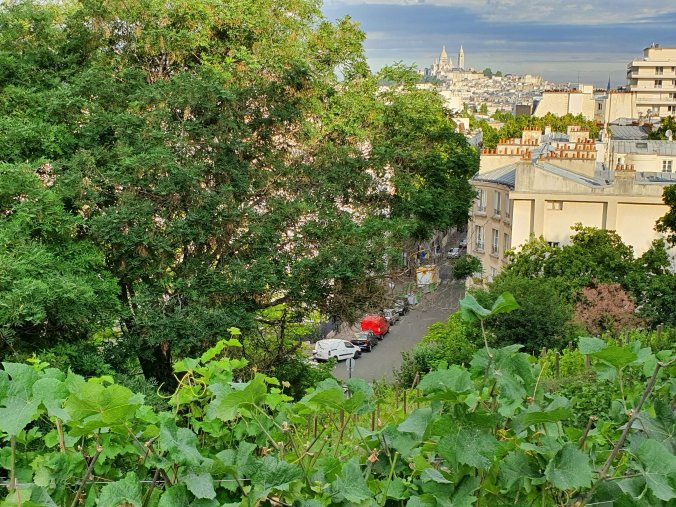
Sacre Couer

Sacre Couer from the bench at the end of the village

How we got there – Butte Bergeyre is located in the 19th arrondissement. We walked there from Marais in the 4th arrondissement taking approximately 1 hour to get there, mostly because we were stopping along the way to observe our surroundings; take photos; and give a directions.

Another thing. On our way back, we also visited Cimitiere Pere Lachaise located in the 20th arrondissement. The beautiful garden cemetery is a tranquil sanctuary with rues of ornate tombs including Oscar Wilde, Jim Morrison and Chopin.

You will love doing this one thing in Barcelona!

As they do in most European countries, the day started slowly. This is typical in summer when cities are buzzing with dining, theatre and music until the early hours.

We step out of our apartment just a few metres away to find Las Ramblas starting to come alive. The leafy promenade runs from Placa de Catalunya, the point where the old town and new town collide down to the Christopher Columbus monument at the port.  The beautiful plane trees conveniently shelter tourists from the strong summer sun. We hear many different languages being spoken around us, but not English!

We are intent on starting our Sunday exploring the back lanes and plazas of the Gothic Quarter before making our way Montjuic Hill for the afternoon. It’s a Sunday and expecting to see the quiet weekend life of the Catalunyian capital, we stroll down an alleyway off Las Ramblas stepping right into the middle of a melee. We see hundreds of people, some clambering on top of each other and while many crowded in groups and others around the perimeter of the square.

We are in Plaza Sant Jaume, the home of City Hall. During the week the plaza is buzzing with town officials going about the business of running this busy seaport city. Weekends, it seems, is for the residents of this vibrant Catalonian capital.

Often the scene for protests, today, residents are using the Plaza for another Catalunyian tradition – building castells or “castles”.

So what is this obsession with building castles?

Unique to the region of Catalunya, forming human castles began in the 18th century when they were built as part of religious festivities. At the end of the celebrations, people formed towers of three or four layers putting on a show to outdo the dancers.

Since the 1980’s, building human towers has become a sport and have grown so much in popularity that there are now competitions to build 9 or 10 tiers of people. The grand finale is a young child clambering up and over team members to raise his arm and four fingers, symbolising the four stripes in the Catalan flag at the top of the tower.

There are at least four teams competing today. Each team dressed in white with black sashes and colourful bandanas representing their allegiance and comradeship. We stand back to observe.

Some of these towers look fragile and precarious, looking as if they will collapse at any moment. However, none of the towers collapse. It is an example of extreme precision, teamwork and commitment with an element of trust involved.  Everyone contributes to the team’s success, from the heaviest to the lightest of participants. The base “pinya” consists of the strongest team members, they must be strong and powerful to form the firm base for the more agile and lighter team member who form tiers supporting others on their shoulders until the lightest climbs to the top. It is the team that forms the tower the quickest that wins.

The atmosphere in the plaza is one of intense concentration coupled with fun and laughter further intensified when the Mayor and his contingent appear on the balcony to watch the proceedings.

Barcelona offers much to the visitor: a colourful history; interesting and amazing architecture; museums and theatres; golden beaches; and a wonderful dining culture. If you want to experience the real Barcelona, do not miss a chance to watch the art of building castells next time you visit.

Looking for something else to do in Barcelona? Read about our day in Palau Guell and why we recommend spending some time there.

A glorious day in the Sonoma Valley

The sky is clear and blue as we drive over the Golden Gate Bridge. What a contrast it is to the day before when we walked over the bridge enveloped in eerie fog as it swirled and rolled all around us. We had experienced the phenomenon of the mixing of the hot inland and the cool ocean air which creates a fog rolling over the Golden Gate Bridge into San Francisco Bay during the summer.

It is not long after enjoying spectacular views while driving over the Golden Gate Bridge that we are surrounded in beautiful countryside, rolling hills and farmland. We are on our way to explore the Sonoma Valley.

When considering visiting wineries in northern California, tourists go to the Napa Valley. Most tours from San Francisco concentrate on taking visitors there in busloads. Not as well known or marketed, Sonoma is the more sedate cousin of the busier Napa Valley. Driving between the valleys typically takes less than an hour and we expected to end our day in Napa.

But we are eager to spend most of our time in Sonoma and surrounds. It is Sonoma’s historic background along with its reputation for producing exemplary wines equal in quality but lesser known than Napa’s wines which has drawn us there.

First stop is the Cornerstone, an indoor/outdoor complex offering boutiques, artisans, and wine tastings. It would be easy to while away a day just wandering their splendid gardens of art. One of Cornerstone’s helpful volunteers gives us advice on what we should do in Sonoma.

Next, we must stop to visit the historic Plaza. It is the largest plaza (town square) in California. A former military outpost and Spanish Mission settlement, the Plaza radiates tranquillity as we drive in. The historic Old Town Hall surrounded by tree-covered park area is in the centre of the Plaza You sense you have stepped back in time. Local people quietly go about their business. There is no hustle and bustle and there is ample parking around the Plaza. Galleries, eateries, wine tasting rooms and artisanal shops sit interspersed between historic landmarks around the four sides of the Plaza and the alleyways leading to discreet courtyards. We spend a couple of hours exploring the historic buildings, having lunch and indulging in sampling local cheese and chocolate. Apart from the tasting rooms, there is little evidence that we are in wine country.

We reluctantly leave this sanctuary. The lovely lady at Cornerstone has suggested we visit one of the more unique vineyards in the region. Benziger Wines is a boutique biodynamic farm and this is an opportunity for us to see how they create their organic wines. We arrive in time to join a small group tour of the farm. The tour takes us on a guided journey through the picturesque vineyards explaining the biodynamic winemaking practices the Benziger family has adopted to produce world-class organic wines. We stop at regular intervals among the grapevines to receive a lesson on grape varieties and to taste wines produced from the grapes. The tour finishes with a stop at the outdoor winemaking area and a tour of the wine caves lined with bottles of wine traversing the ageing process. 300,000 bottles of wine are produced annually by the vineyard. A visit to the tasting room completes our visit. We have gained an appreciation of the distinctness of the organic product.

There is just enough time to carry on through the rolling hills and valleys of vineyards to Napa. Not to visit any more vineyards or wineries, but to complete a day out with a meal in the wine capital of northern California.

Were we happy with our choice to visit Sonoma? Being simple travellers spending time wandering the Sonoma settlement and surrounding countryside was more appealing than battling the large numbers that descend on the Napa. Indeed, it was a glorious day out.

An exhilarating day trip to Kotor in Montenegro!

We have a spare day in Dubrovnik. We could take a ferry ride to visit the charming islands off the coast. Alternatively, we could spend the day exploring Montenegro’s natural beauty away from the summer crowd.  Kotor is less than 100 km away! We decided to take what turned out to be an exhilarating day trip to Kotor in Montenegro!

Still relatively untouched by mass tourism, this little country has a lot to offer. It is the ideal place to experience a mix of history and natural beauty.

Rather than rushing from one town to another, we idle away a few hours in Kotor. We walk along the city walls and then through the labyrinth of streets. We wander in and out of squares admiring the baroque churches and locals.

Our Dubrovnik host suggested leaving early. Doing so avoids long queues at the Croatian border when Montenegrins and Croatians travel. At times the wait can be two hours or more. The evening wait time can sometimes be longer!

We stop for lunch at a small cafe in a quiet square in the Kotor’s Old City and were lucky to chance upon an informative cafe owner. While discussing our apprehension, he suggests we make our return trip through Bosnia and Herzegovina. He often takes this route. He reassures us the journey is scenic. The travel time will be the same so we jump at the opportunity to have a taste of driving through the countryside. Of course, the idea of avoiding languishing in a long queue also helps us make the decision.

With instructions on where to turn off the main road, we set both GPS devices with the details (our lease car’s GPS is more than adequate, however, we also take our trusty TomTom GPS unit with us too when we travel – just in case!).

Both GPS devices instruct us to turn off the road just out of Kotor onto a quiet little backroad which soon turns into a country lane and then into a goat track. We wave down a decrepit ute driving past us in the opposite direction to make sure we were on the right path. He can’t speak English but he waves us on indicating we are going the right way.

We drive on expecting the road to improve and join a major arterial road. To our horror, the road narrows further as climb uphill on this vertiginous track with nowhere to safely turn back. There is no option but to crawl forward at times reaching 20km/hour.  Not to mention the 30 or so hairpin bends we encounter over this hair-raising drive with sheer mountain drops (and stunning views). However, we are intent on staying on the track and don’t dare take our eyes off the road until we reach the top where we came across two hikers taking a relaxed hike along the road. These are the only humans we have seen since the man in the ute. A little further on, join the road we are actually supposed to have been travelling on.

The bypass is so new that it didn’t feature on either GPS units.

We are fortunate.  He is an accomplished driver and contains his racing driver spirit until we arrive on the highway to continue a most enjoyable time through the Bosnia and Herzegovinian countryside surrounded by rolling hills, through green valleys alongside gently flowing streams and creeks and quaint towns arriving back in Dubrovnik without incident.

We are, however, curious. A Google search when we arrive back in Dubrovnik reveals that we have just traversed one of the most dangerous roads in Europe!

Toast the New Year in with Champagne!

The year is drawing to a close and we feel a sense of satisfaction for accomplishing our planned travel goals with a few unplanned journeys thrown in.

As we prepare to toast in a New Year, memories of a few special days in the Champagne region of France come to mind.

After a few days of seeing the city through Parisienne eyes and wandering the rues and boulevards of Paris, we collected our car to begin our road trip.

First stop is the city of Reims. The unofficial capital of the Champagne region in the northeast of France is the perfect place to base ourselves for a day or two to explore the region.

Reims is not only the centre of the Champagne. It is home to some architectural wonders, including the imposing Notre Dame Cathedral (where French kings came to be coronated), the beautiful City Hall, the Basilica St Remi and many admirable squares.

Many of the regions Champagne houses including Taittinger and Mumm are headquartered in Reims and offer tastings at their cellar doors. Their houses are accessed through grand entrances and beautifully manicured gardens. An indication of the high esteem the French hold for champagne.

After admiring the city, we spend a couple of days exploring further afield.

Day 1 is a short 25km drive to Epernay, the home of the world’s highly acclaimed champagne houses.

On arrival, we find the streets deserted and not teeming with tourists as we had expected at the height of the European summer. It is lunchtime and everything apart from eating establishments are closed for lunch.

The Avenue de Champagne is undoubtedly one of the most beautiful streets we stroll along. Even more stunning when you have the street to yourself. We wander in and out of the grand champagne houses amidst beautiful grounds and gardens. These are the best champagne producers in the world!

We are disappointed at our first stop, the famous house of Moet and Chandon. The cellars are closed for refurbishment until after summer. We are directed a little further up the road to the House of Mercier. A partner of Moet and Chandon and owned by the LVMH group of companies, Mercier champagne is the most popular champagne in France. Eugene Mercier established his champagne house with the intention of making champagne readily available and affordable to all so that it was not only consumed for a special event but so it would become part of everyday occasions. The tour of the underground caves (18km long), on a laser-guided autonomous tram, provided an insight into champagne production, the different stages of the ageing process along with an added surprise – the remarkable basal reliefs that decorated the walls of the underground caves.

Of course, the tour would not be complete with a tasting. We enjoyed tasting the “wine for the people” complete with a lesson on how to distinguish between the different varieties. Though not connoisseurs, and now having tasted both Moet and Mercier champagnes, we agreed, both were not dissimilar!

The day ended with a leisurely drive back to Reims through the vineyards around Verzenay.

Day 2 is a beautiful summer day to take a slow 30-minute drive along the backroads among grapevines and vineyards to Hautvillers, home of another vintage champagne, Dom Perignon. The roads are quiet and we wonder why we have the roads to ourselves, there is not another vehicle in sight. It appears that everyone else is in a hurry and prefers to take the motorway.

Dom Pérignon (1638–1715) was a monk and cellar master at the Benedictine abbey in Hautvillers, a quaint French village. His tomb is in the little Abbey and remains devoid of tourist traffic.

We wander through the village and along the narrow lanes to find picnic grounds at the top of the hill. The views over vineyards and down to the little village of Cumieres and the aqua waters of the River Marne are breathtaking. This is heaven.

It is decided, we drive back to Reims via Cumieres on roads set amongst the vineyards and the gently sloping countryside through small champagne villages. The perfect end to a perfect day.

Our road trip had just started and we continued our journey through Burgundy, Provence, Bordeaux and the other wine producing regions of France. However, we will cherish our few days in Champagne.

If you are planning a visit to Paris and have a couple of spare days, take a short sojourn in the Champagne region, you will not regret it.

P.S.  A short champagne lesson:

Brut – 40% pinot noir, 45% another white wine, 15% Chardonnay, contains 9% sugar. Brut is aged for 2 years and is then ready to drink. It should not be kept for more than 3 years.

Rose – has red wine added.

Demi-Sec is much sweeter with up to 40% more sugar. It is a dessert wine.

Brut Reserve has more reserve wine added and the taste can change from year to year depending on the reserve added.

No year on the bottle – no vintage!

« Older posts Newer posts »

© 2026 Travelling Simply

Theme by Anders Noren — Up ↑